The Story Board
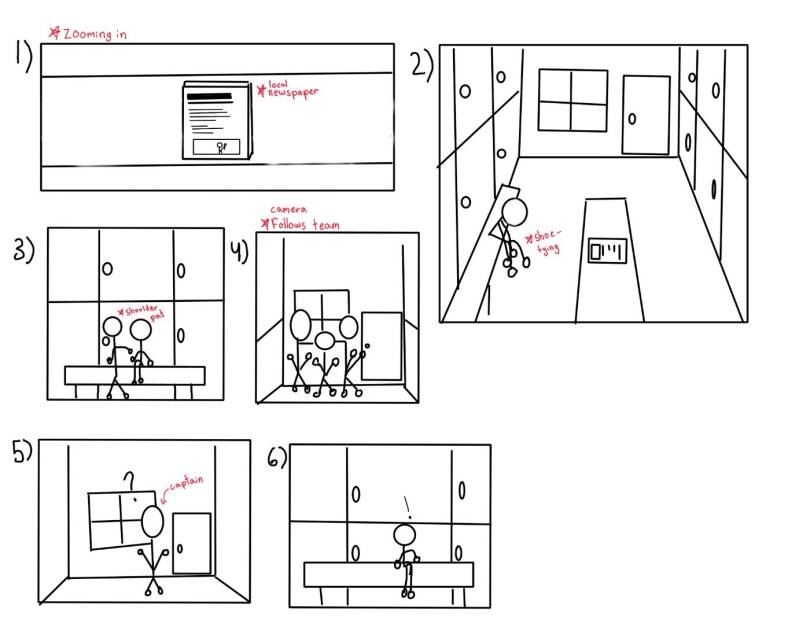
Story boards are crucial to getting your ideas across. They provide a visual to compare to your work, and they can also act as a pitch of some sorts. They don't need to be too detailed, just a general overview of what the visuals would look like.
References
When storyboarding, it's important to look at references. Whether that be a still from another film, or something as simple as a colour scheme, references are crucial to gaining inspiration.
Some references that were used in terms of colour grading include La La Land, Do the Right Thing, Blade Runner 2049, and the television show Arcane.
Colour grading is essential to conveying the emotions felt in a scene. There is also a thing called the "60-30-10" rule, which consists of adding 60% of one colour, 30% of another, and 10% of the last. This 60-30-10 rule helps add a sense of cinematic depth and keep the shot balanced.
Photo Credits: The Television show Arcane

The First Draft
Story boards don't need to be too detailed, especially in the first draft.
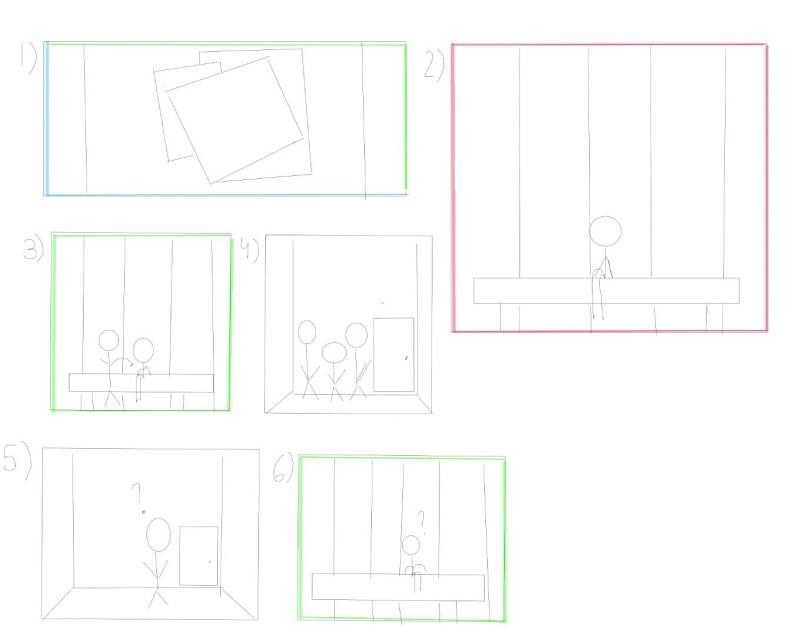
For my first draft, I tried not to think about it too hard, rather, I just tried to get my ideas down. I started by deciding which frames I deducted "important" enough to get down.
I started by focusing on one scene and not think about the others. This is important because it helps put yourself in both the character's and the audience's shoes. They don't know what happens next; so, how can that be conveyed through the frames?
The photo beneath shows my first draft, the red frames representing frames I decided angles needed to be changed while looking back, the blue representing frames I knew I wanted to include, and the green representing frames that needed more detail or consistency.
The Final Story Board
Creating the final story board took me about an hour. This is because I had to look back and decide which frames are important to include and which ones can be removed.
This also gave me a time to improve the drawings and add more detail. This doesn't necessarily mean it has to be detail-heavy, just enough to include the general idea of the set, characters, and frames. I also added extra writing (isn't typically seen in story boards) in order to get my idea across more clearly.